
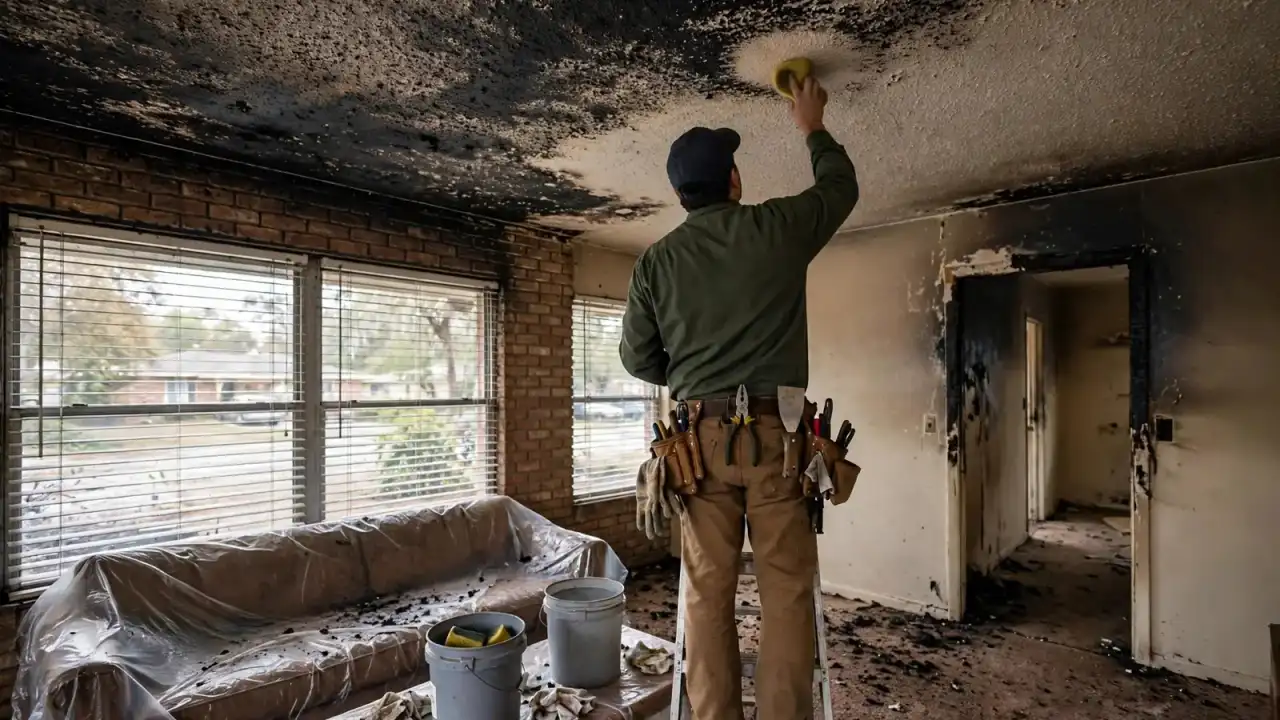
Key facts: Soot Removal
- Soot is fine carbon left by incomplete burning, mixed with oily and acidic by-products that vary with the fuel.
- Humidity helps soot bond to surfaces, so prompt removal matters more in damp climates.
- Dry removal with HEPA vacuums and dry sponges normally comes before any wet cleaning.
- Fine combustion particles can harm the lungs and heart, especially in sensitive groups [1].
- The IICRC S700 document sets out recommended practice for fire and smoke cleanup [2].
Understanding soot
What soot is made of, and why it matters here
Soot is what a fire leaves when it cannot burn its fuel completely. Some of the fuel breaks into microscopic carbon particles, and those particles carry tars, oils and acids with them as hot smoke spreads through the house. When the smoke cools, the particles fall out onto ceilings, upper walls, door frames and anything rough or cool enough to catch them.
The fuel shapes the residue. Paper and wood burning hot leave a dry, gray powder. Furniture foam, plastic toys, electronics and synthetic carpet smolder into a black, greasy film. Food left on a burner leaves a pale, sticky layer with a powerful smell. Most house fires burn a mix of all three, so a single room can carry several kinds of residue.
Houston adds a complication: moisture. Air that is humid for much of the year, plus water from the fire hoses, turns dry soot into something closer to paste. Damp residue grips paint and texture more tightly and smears more easily. That is one reason restorers here try to start soot work as soon as the house is dry enough to clean.
Soot is also mildly corrosive. Left in place, its acids yellow plastics, tarnish chrome and brass, cloud glass and darken grout. Every day it sits makes the job harder.
Where it settles
Houston surfaces that hold soot
Acoustic and knock-down ceilings
Textured ceilings, common in Houston homes from the 1960s onward, trap soot in their peaks and hollows.
Brick fireplaces and interior brick
Porous brick and mortar joints soak up soot and need masonry-safe methods.
Painted wood trim and paneling
Older homes have wood trim and paneling that take residue into the grain.
Ceramic tile with wide grout
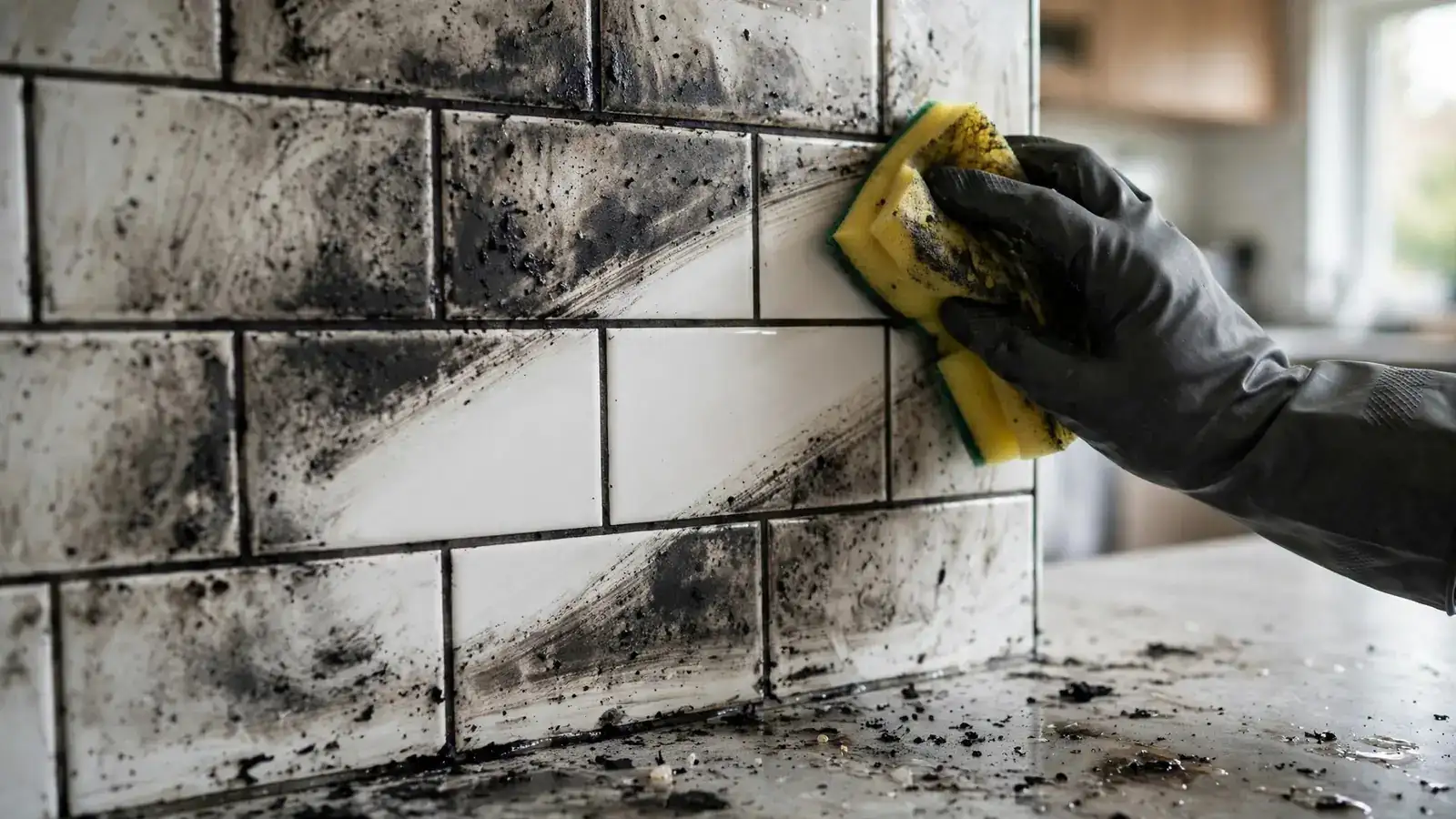
Glazed tile wipes clean, but grout lines darken.
Ceiling fans
Nearly every Houston room has one; the blades carry a heavy layer on top.
Window blinds and shutters
Slats collect film on every edge.
Spread
How soot travels through a Houston home
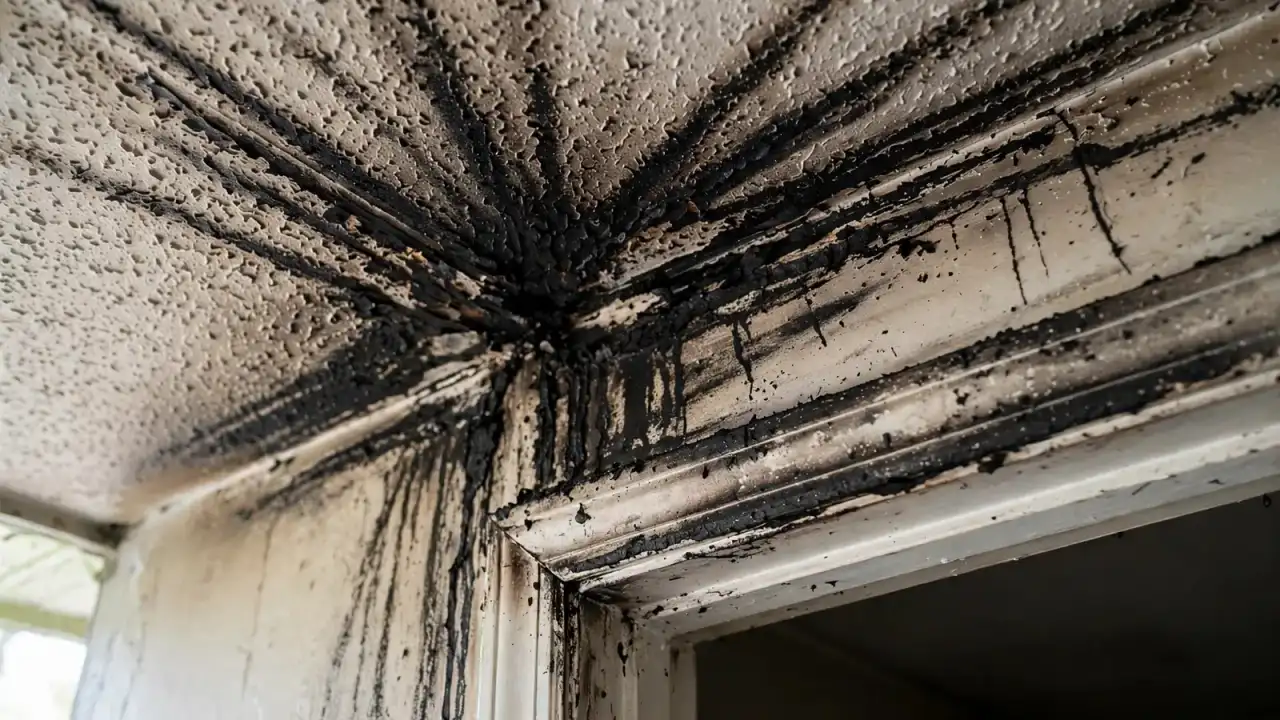
Smoke moves under pressure. It squeezes under doors, through gaps around ceiling lights and the attic access, and into the ductwork if the air conditioning was running, which in Houston it usually is. In a single-story ranch, the attic connects every room; in a two-story home, the stairwell carries smoke straight up to the bedrooms.
Older homes on pier-and-beam foundations, common in the Heights, Montrose and the Third Ward, have a crawlspace under the floor. Smoke can drift into it through floor registers and gaps and coat the underside of the floor and any ductwork running below.
Cool surfaces pull particles out of the air, so air-conditioned rooms, exterior walls and the ceilings below supply ducts often show dark lines and shadows. A full inspection covers every room, closet, cabinet, the attic, the crawlspace if there is one, and the cooling system.
Diagnosis
Testing before the first wipe
These quick tests prevent the hardest mistake to undo.
- 1
Dry sponge test
One stroke on a hidden spot shows whether soot lifts or smears.
- 2
Surface check
Texture, paint sheen, brick, wood and fabric each tolerate different cleaners.
- 3
Moisture check
Damp materials are dried first; cleaning wet soot spreads it.
- 4
Spot wet test
A mild cleaner is tried somewhere hidden to check for damage.
- 5
Older material check
Textures and tiles in pre-1980s homes may need asbestos testing. [3]
Diagnosis
Reading the residue
| What you see | Likely source | Usual first step |
|---|---|---|
| Gray powder on walls | Hot wood or paper fire | HEPA vacuum, then dry sponge |
| Black smears on paint | Plastics, foam or electronics burned | Dry pass, then degreaser |
| Tacky film in the kitchen | Burned food | Protein cleaner |
| Soot in brick mortar lines | Smoke past a fireplace wall | Masonry-safe cleaning |
| Dark lines on textured ceiling | Cool framing drew particles | Clean or seal, then retexture if needed |
| Gray film in far bedrooms | Smoke through the attic or ducts | Room cleaning and duct check |
The process
How soot is removed, step by step
Cleaning moves from the top down and from dry to wet. Ceilings come first so falling residue lands on surfaces not yet cleaned. HEPA vacuums collect loose particles without blowing them around. Dry chemical sponges follow on paint and light texture, drawing residue into the sponge rather than smearing it.
Wet cleaning comes only after the dry pass, with products matched to the residue: alkaline cleaners for most smoke film, degreasers for oily soot, protein cleaners for kitchen fires. Brick is brushed and cleaned with masonry-safe products and rinsed with as little water as possible. Textured ceilings are handled gently; heavy soot on popcorn or acoustic texture is often sealed or the texture replaced, after testing older textures for asbestos.
Contents are handled separately. Hard items are cleaned by hand or ultrasonically, soft goods go to smoke-capable cleaners, and electronics stay unplugged until inspected. Everything that leaves the house is listed.
Finally, surfaces that still show a shadow get a stain- and odor-blocking primer before fresh paint.
Methods
Matching method to surface
| Method | Good for | Not for |
|---|---|---|
| HEPA vacuuming | Every surface first | Nothing; always step one |
| Dry chemical sponge | Flat paint, light texture | Greasy film, heavy popcorn texture |
| Alkaline detergent | Gloss paint, tile, laminate | Unsealed wood |
| Degreaser | Oily soot on hard surfaces | Some plastics |
| Masonry cleaner | Brick and stone | Drywall |
| Blasting | Charred framing and attic wood | Finished rooms |
| Ultrasonic tank | Small hard contents | Electronics or porous goods |
Before help arrives
What you can do while you wait
Turn the thermostat fan off so the air conditioning is not circulating particles. Close doors to the worst rooms. Lay old sheets on floors along the paths you use. If the power is on and safe, a dehumidifier in a closed room helps keep soot from going tacky.
Leave the cleaning to the crew. Wet rags, regular vacuums and ceiling fans make soot problems bigger. Photograph every room first.
- AC fan off
- Doors shut on sooty rooms
- No wet rags on soot
- No ceiling fans
- Photos first
The visit
What the first visit looks like
The contractor will ask what burned, how long, whether water was used and whether the AC was running, then walk every room, open cabinets and closets, check the attic and look at the return grille. Containment comes next: plastic sheeting at doorways, floor protection and HEPA air scrubbers. Contents that can be cleaned on site are; others are packed out with an inventory.
Ask how they document their work. Photos, a contents list and notes on what was cleaned, sealed or removed make an insurance claim smoother.
Houston specifics
Soot cleanup in the Houston climate
Houston's humidity is the defining local factor. Damp air makes soot tackier and speeds mold growth on any materials left wet from firefighting. Restorers often run dehumidifiers while cleaning, and they prioritize drying before soot work so residue is not driven deeper.
Housing varies widely across the city: early twentieth-century bungalows on piers, 1950s and 1960s brick ranches with acoustic ceilings, 1970s and 1980s apartment complexes, and new townhomes and two-story builds. Each has its own soot challenges, from crawlspaces to tall stairwells.
Hurricane season matters too. If a fire happens in late summer or autumn, a storm may follow before repairs are finished. Board-up and tarping must hold, and any new water must be dried quickly.
Prevention
Keeping soot problems small
- Run a dehumidifier in damp seasonsLower humidity helps keep everyday residue from bonding.
- Service gas appliancesA poorly burning furnace or water heater can puff soot and produce carbon monoxide.
- Trim candle wicksLarge flames leave soot on walls over time.
- Change AC filters oftenHouston systems run most of the year; fresh filters catch more particles.
- Keep garages organizedPlastics and chemicals near heat make heavy, oily soot.
Deciding
Clean, seal or replace
Glass, glazed tile, metal and sealed counters almost always clean. Painted drywall usually cleans and then gets primer and paint. Brick cleans with the right methods. Textured ceilings, unsealed wood, grout and fabrics are less predictable, and anything warped, blistered, melted or charred is generally removed. Insulation that took smoke is replaced. A contractor should explain each decision and photograph materials before removal.
Contents
Soot on belongings
Dishes, decor, lamps, toys and tools all carry residue, as do the insides of drawers. Hard items are hand or ultrasonically cleaned. Clothing and linens go to smoke-capable cleaners. Books, papers and photographs are cleaned with gentle dry methods; if wet, they can be frozen until a specialist can dry them, which matters in Houston's humidity, where wet paper molds quickly. Electronics stay unplugged until checked.
Older foundations
Pier-and-beam homes and crawlspaces
In older pier-and-beam homes, soot and smoke can reach the crawlspace through floor openings. Residue on the underside of the floor and on ducts below keeps releasing odor upward. Cleaning these homes includes the crawlspace: removing smoky insulation, cleaning or sealing framing and checking ducts. Crawlspace work is a job for a protected crew, not a homeowner.
Related
Problems that usually come with soot
Lingering smoke smell
Odor remains in porous materials.
Read moreWet materials from firefighting
Drying comes before cleaning.
Read moreSmoke through the whole house
Distant rooms carry a film.
Read moreMold after a fire
Houston humidity speeds it up.
Read more
Garages
Garage fires in attached garages
Most Houston houses built since the 1960s have an attached garage, and garages hold the materials that make the worst soot: gasoline cans, paint, pool chemicals, plastic storage bins, lawn equipment and, more and more, e-bike and power-tool batteries. When a garage fire is caught early, the house beside it may still be filled with oily black residue that pushes through the connecting door, attic and any return air that pulls from the garage side.
Garage residue is usually the heaviest and greasiest in the house, and it often needs degreasers and repeated passes. The shared wall and the ceiling above the garage are checked closely, and insulation in that part of the attic is frequently replaced. Before anyone moves stored chemicals, they should be checked for heat damage and disposed of through the city's household hazardous waste program if their containers have softened or bulged.
Finishes
Soot on common Houston finishes
| Surface | Usual outcome | Notes |
|---|---|---|
| Flat latex wall paint | Cleans, then primer and paint | Dry sponge first |
| Semi-gloss trim | Usually cleans well | Check corners and tops of doors |
| Acoustic or popcorn ceiling | Often sealed or replaced | Test older textures for asbestos |
| Interior brick | Cleans with masonry methods | Sealer helps afterwards |
| Laminate cabinets | Exteriors clean; heat can lift edges | Clean insides too |
| Vinyl plank flooring | Usually cleans | Check seams if water was used |
| Carpet | Often replaced after heavy soot | Pad absorbs odor |
Order of work
Drying first, then cleaning
In Houston, many fire scenes are wet. Firefighters may have used a great deal of water, and summer humidity keeps everything damp. Restorers usually extract standing water and start drying with dehumidifiers and air movers before finishing soot work. Wiping soot off wet drywall or ceilings tends to drive it deeper or leave tide lines, so the sequence matters.
Mold is the other reason to dry first. On damp drywall, wood and carpet pad, mold can start within a day or two in warm weather. Drying, moisture readings and removal of materials that cannot dry are part of the same job. The page on water damage from firefighting explains how drying is measured and when it is done.
HVAC
Ductwork and the cooling system
Houston homes run air conditioning for much of the year, so the system is often moving air when a fire starts. That pulls smoke into the return, across the coil and filter and out through every supply vent. Afterwards, gray rings appear around ceiling registers and a smell returns each time the system starts.
A full soot job checks the return grille, filter, blower, coil and accessible ducts. Flexible duct with heavy residue or heat damage is usually replaced rather than cleaned, while metal trunk lines are cleaned. Until the system has been looked at, keep it off if you can, or at least run it only with a fresh filter after the main cleaning is done. Smoke damage cleanup covers the system in more detail.
Choosing help
Questions to ask a soot contractor
- How will you test the residue?A good answer mentions dry sponge tests and checking surfaces before cleaning.
- Will you dry before you clean?On wet Houston fire scenes, drying usually comes first.
- How do you protect rooms not affected?Containment with plastic and air scrubbers stops spread.
- Do you clean contents, or only the structure?Some firms do both; others refer contents to specialists.
- What documentation will I get?Photos, notes and contents lists help with an insurance claim.
- Do you test older textures for asbestos?Older acoustic ceilings and some flooring should be tested before disturbance.
Insurance
Insurance and soot cleanup in Texas
Most Texas homeowners policies cover sudden fire and smoke damage, including cleaning, though terms vary and deductibles apply. The Texas Department of Insurance publishes consumer guidance on filing claims, deadlines and what to do if you disagree with an adjuster. Report the fire to your insurer promptly, ask in writing what is covered, and keep copies of every estimate and invoice.
Insurers often send their own adjuster and may suggest a preferred contractor; in Texas you can generally choose who does the work, but confirm with your insurer before work begins so the scope is agreed. Photos taken before cleaning are some of the most useful evidence you can keep.
Generators and candles
Soot after a hurricane-season power outage
When storms knock out power across Houston, as Hurricane Beryl did in July 2024, households turn to candles, camp stoves and portable generators. Each of these can leave soot, and some cause fires. Candle soot builds up as dark streaks above where candles burned and on ceilings. Generator exhaust drawn indoors carries soot and deadly carbon monoxide. If a room shows new black streaks after an outage, find the source before cleaning, and keep generators outside, well away from doors, windows and vents.
FAQ
Houston soot removal questions
Why does soot feel sticky in my house?
Humidity and firefighting water make soot tacky, so it bonds to surfaces and smears when wiped.
Can I wash soot off my walls?
Not as a first step. Dry methods come first, or the soot spreads into the paint.
Should I run a dehumidifier?
If power is safe, yes. Lower humidity helps keep soot from setting and slows mold.
Will my popcorn ceiling need replacing?
Light soot can sometimes be cleaned or sealed. Older textures should be tested for asbestos before any work.
Is soot harmful to breathe?
Fine particles can affect the heart and lungs. Limit time in affected rooms and wear a fitted N95.
Can brick be cleaned after a fire?
Usually, with masonry-safe methods and a breathable sealer.
Does soot get under pier-and-beam homes?
It can, through floor openings. The crawlspace may need cleaning.
Will paint cover soot stains?
Not alone. Clean first and use a stain-blocking primer.
Can soot tarnish fixtures?
Yes. Acidic residue pits and tarnishes metal within days.
What is the IICRC S700?
An industry document on fire and smoke cleanup practice. Ask whether the contractor's crews follow it.
Who cleans soot in my apartment, me or the landlord?
The landlord usually handles the building; your belongings fall under your renters insurance if you have it. Report residue in writing.
Why is garage soot so greasy?
Fuels, plastics and chemicals stored in garages burn into heavy, oily residue that needs degreasers.
Should my AC ducts be cleaned after a fire?
If the system was running, the ducts, coil and blower should at least be inspected, and often cleaned.
Can I choose my own restoration contractor in Texas?
Generally yes, but agree the scope with your insurer before work starts.
Can candles alone cause soot stains?
Yes. Burning many candles during an outage often leaves dark streaks on walls and ceilings.