
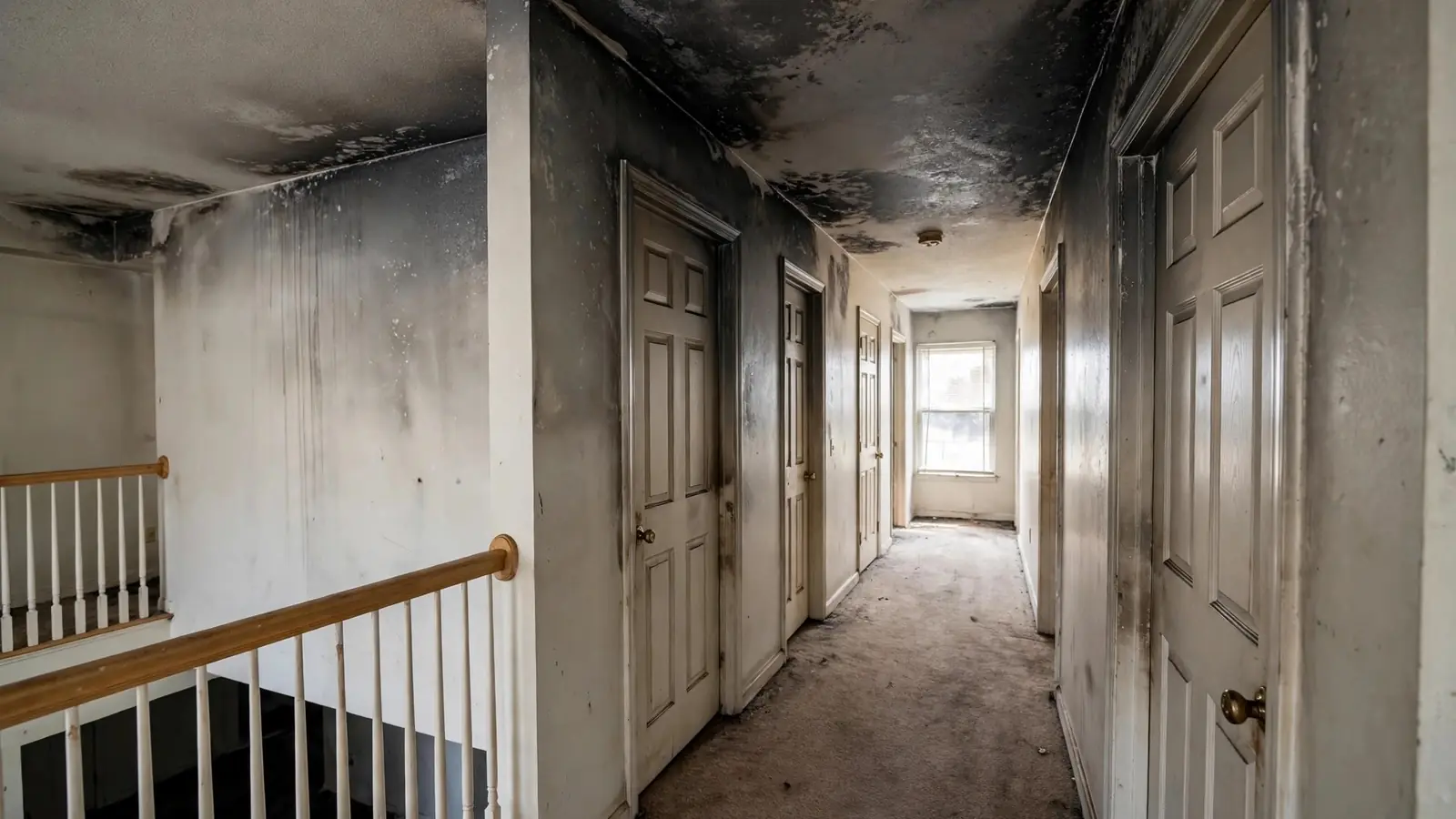
Key facts: Smoke Damage Cleanup
- Smoke carries particles and gases that settle far from where a fire started.
- Air conditioning that runs during a fire can carry smoke to every room.
- Fine particles from smoke can affect the lungs and heart [1].
- Cleaning removes residue; deodorizing alone only hides smell for a while.
- The IICRC S700 sets out recommended practice for fire and smoke restoration [2].
The basics
What smoke damage actually is
Smoke is a moving mix of hot gases, water vapor and tiny solid and liquid particles. As it travels away from the fire it cools, and the particles drop out onto whatever they meet. The gases soak into anything porous. What remains is two problems that need separate answers: a visible film on surfaces and an invisible load of odor inside materials.
How bad the damage is depends on the fuel, the heat and how long the smoke had to spread. A quick, hot fire may leave less residue than a long smolder, which pushes thick, oily smoke into every corner for an hour before anyone notices. Synthetic materials, which fill modern homes, produce darker and stickier smoke than wood.
Smoke residue is also acidic. Over days it etches glass, tarnishes metal fittings, yellows plastic switch plates and discolors grout. Prompt cleaning protects finishes that would otherwise need replacing.
Paths
Where smoke goes in a Houston home
The attic
In single-story ranches, the attic links every room above the ceiling.
The air conditioning
A running system pulls smoke into the return and pushes it out every vent.
Stairwells
In two-story homes and townhomes, smoke rises straight to bedrooms.
Closets and cabinets
Closed spaces trap smoke and hold odor in clothing and linens.
Crawlspaces
Older pier-and-beam homes can take smoke through floor openings.
Shared walls
In apartments and townhomes, smoke passes into neighboring units.
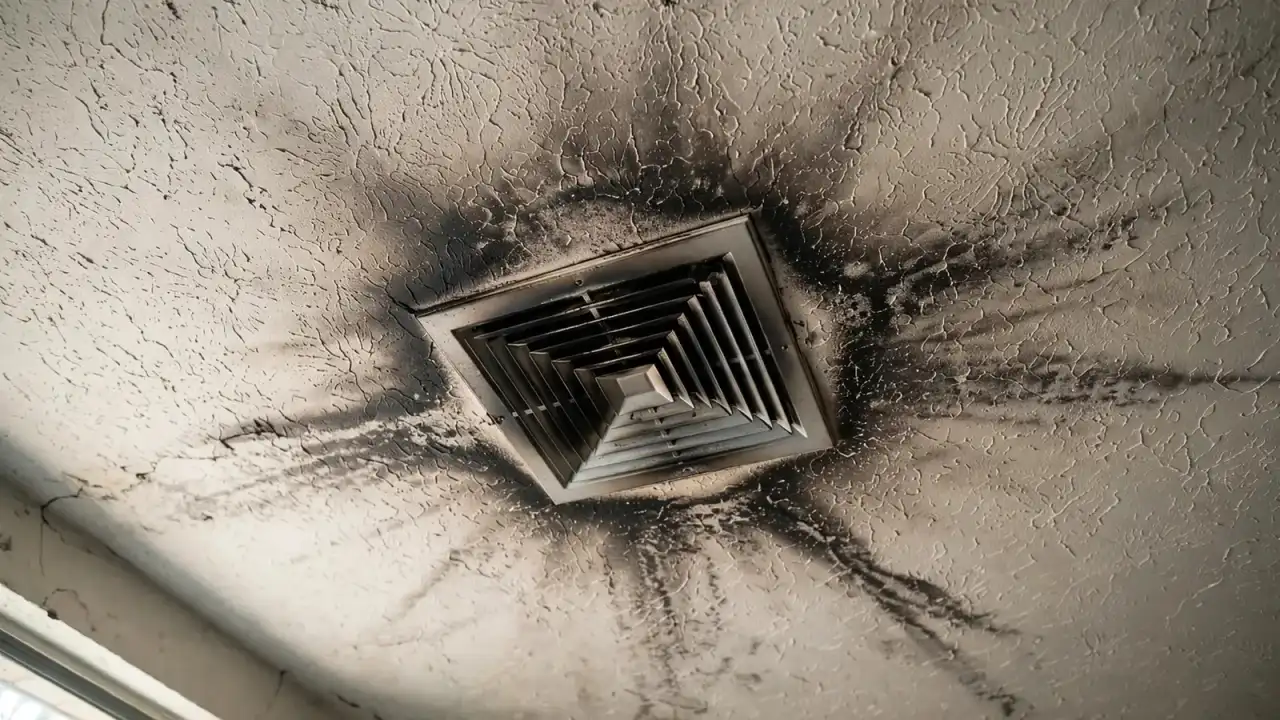
Hidden damage
Why the far rooms matter
It is easy to focus on the room where the fire burned and miss the rest of the home. Yet bedrooms at the far end of a hall, closets full of clothes and the attic above often hold enough residue to keep the smell coming back for months. A careful inspection opens every closet, drawer and cabinet, looks at the tops of door frames and ceiling fan blades, lifts the attic hatch and checks the return air grille.
Contractors often use a simple test: a dry sponge wiped across a ceiling in a room that looks clean. If it comes away gray, that room needs cleaning too. Moisture meters, thermal cameras and odor checks help map the rest.
The process
How smoke cleanup usually runs
The order matters as much as the methods.
- 1
Make the home safe
Power, gas and structure checked; wet areas identified.
- 2
Inspect and map
Every room, closet, the attic, ducts and crawlspace, if any, are checked.
- 3
Contain and protect
Plastic at doorways, floor protection and HEPA air scrubbers.
- 4
Dry first where wet
Extraction and dehumidifiers before final cleaning.
- 5
Clean top to bottom
Ceilings, walls, trim, cabinets inside and out, then floors.
- 6
Deal with the system
Return, filter, coil, blower and ducts inspected and cleaned or replaced.
- 7
Deodorize
Only after residue is gone, with methods matched to the home.
- 8
Seal and finish
Odor-blocking primer and paint where needed.
Residue
Smoke residue types
| Fire type | Residue | Cleaning notes |
|---|---|---|
| Wood, paper, cardboard | Dry gray powder | Dry methods lift most of it |
| Furniture, plastics, electronics | Black, oily film | Dry pass first, then degreasers |
| Cooking fire | Clear or yellow sticky film | Protein cleaners; strong odor |
| Electrical fire in a wall | Localized heavy soot, burned-plastic odor | Wiring checked by an electrician |
| Outside smoke (grass or industrial) | Light film in filters and fabrics | Filters, laundering, duct check |
Shared buildings
Apartments and townhomes
Houston has a huge stock of apartments and a growing number of three-story townhomes, particularly in inner neighborhoods. In both, units share walls, attics or roof structures, and smoke from one home can reach several others. Neighbors may notice a smell or film days after the fire, often in closets and on ceilings along the shared wall.
In an apartment complex, the property owner or management company usually coordinates cleaning of the building and unit surfaces, and residents look after their own contents through renters insurance. Townhome owners often deal with a homeowners association for shared roofs and exteriors. In both cases, write down what you see, photograph it, and report it in writing so there is a clear record.
First steps
While you wait for cleanup
Keep the air conditioning fan off if smoke residue is visible near vents. Open windows only if outside air is clean and it is safe. Close doors on the worst rooms and keep pets and children out.
Take photographs of every room, the inside of closets and the attic hatch before anything is moved. Bag clothing and linens that smell of smoke and set them aside for professional cleaning rather than washing them at home with regular detergent, which can set the odor.
- AC fan off near sooty vents
- Doors closed on the worst rooms
- Photograph everything
- Bag smoky fabrics
- No home washing of heavy smoke
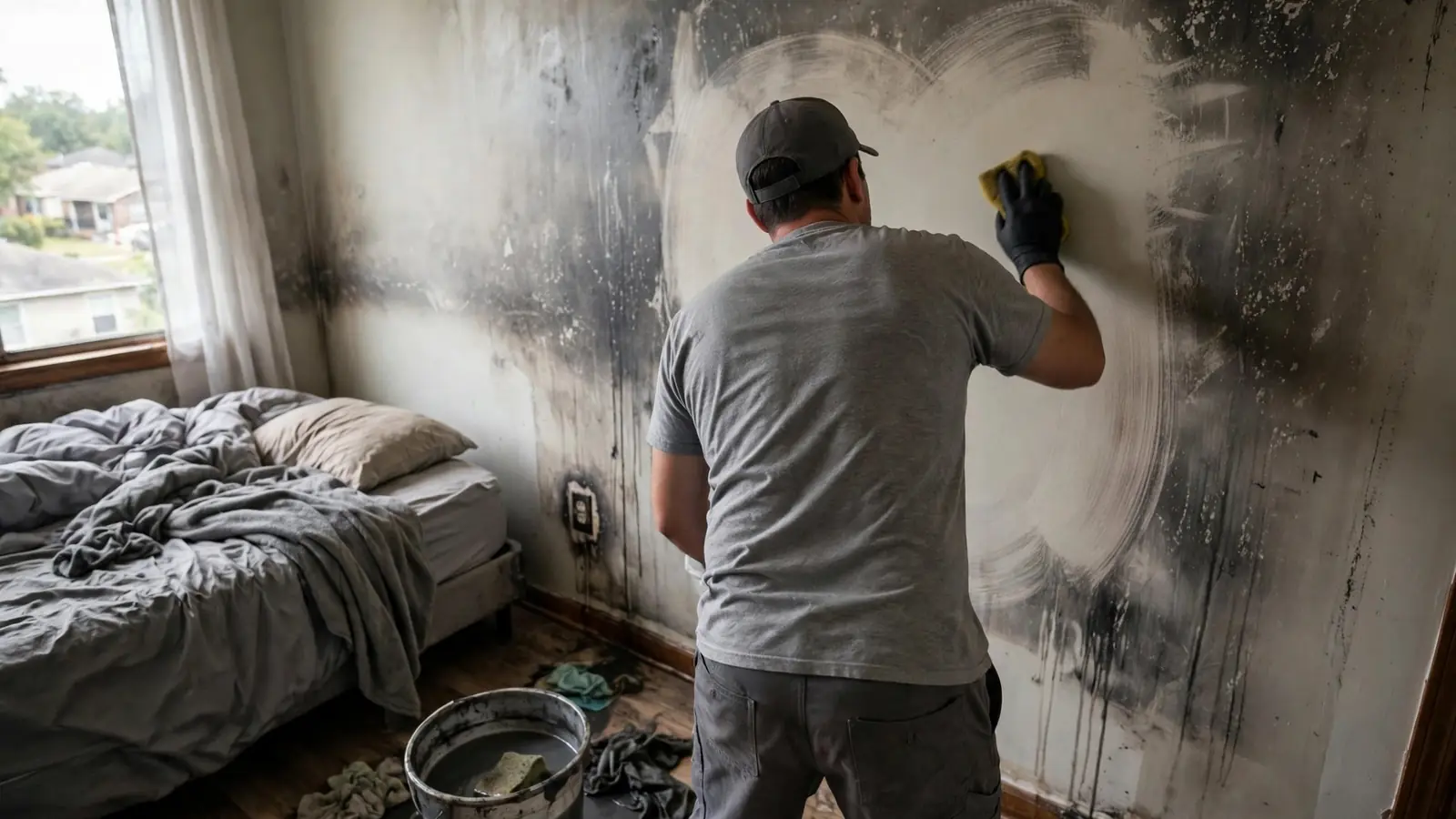
Local conditions
The Houston factors
Three things set Houston smoke jobs apart. First, humidity: damp air makes residue tackier, encourages mold on wet materials and slows natural airing out, so restorers often run dehumidifiers throughout. Second, air conditioning: systems here run most of the year, so smoke is very often pushed through ducts to every room. Third, housing variety: the city mixes 1920s bungalows on piers, mid-century brick ranches, garden apartments and new three-story townhomes, and each moves smoke differently.
Storm season adds pressure. A fire in August or September may be followed by tropical rain, so any opening in the roof or walls needs to be secured quickly. Board-up and tarping is often the first thing done on a damaged house.
Materials
Cleaning by material
| Material | Typical approach |
|---|---|
| Painted drywall | Dry sponge, then wet clean, then primer if shadows remain |
| Textured ceilings | Gentle cleaning or sealing; test older textures for asbestos |
| Wood cabinets | Cleaned inside and out; finish checked for damage |
| Hard flooring | Cleaned; seams checked if water was used |
| Carpet and pad | Cleaned if light; pad often replaced |
| Clothing and linens | Professional smoke laundering or dry cleaning |
| Electronics | Unplugged and inspected before use |
| Attic insulation | Usually removed and replaced if smoky |
Air system
Ducts, coils and filters
If the system ran while there was smoke, assume the ducts carry residue. Filters are replaced immediately. The return plenum, blower and evaporator coil are cleaned. Metal ducts can be cleaned with brushes and HEPA vacuums; flexible duct, common in Houston attics, often holds residue in its inner liner and is usually replaced when heavily affected. Registers and grilles are removed and cleaned. Running the system before this is done can recontaminate rooms already cleaned.
Contents
Fabrics, furniture and belongings
Smoke settles into upholstery, mattresses, curtains, rugs and clothing. Washable items often come clean with professional smoke laundering; delicate or dry-clean-only items go to specialist cleaners. Upholstered furniture may be cleaned if residue is light, but foam that absorbed heavy smoke is hard to clear. Hard items such as dishes, decor and tools are hand-cleaned. Paper and photos need gentle handling. A full inventory with photos protects you if items are removed or replaced.
Smell
Odor follows residue
Smell is the part of smoke damage people notice longest. It comes from gases trapped in porous materials and from residue still on surfaces. That is why cleaning comes first: deodorizing over residue is like spraying air freshener in a smoky room. Once surfaces are clean, contractors use methods such as thermal fogging, hydroxyl generators or, in unoccupied homes only, ozone, then seal surfaces with primer. The EPA warns ozone generators should not be used in occupied spaces [3]. Odor removal covers these choices in detail.
Checks
Signs a room still needs work
- Smell returns on warm daysHeat releases odor still held in materials.
- Gray on a dry sponge testResidue remains on the surface.
- Smell when the AC startsThe system or ducts still carry residue.
- Yellowing on switch platesAcidic film was missed.
- Odor inside closetsFabrics or shelves need attention.
Outdoor sources
Smoke from outside the home
Not all smoke damage starts inside. Houston sits beside one of the largest petrochemical complexes in the country, along the Ship Channel and in nearby Deer Park, Pasadena and Baytown. Plant fires, such as the 2019 tank fire at the Intercontinental Terminals Company site in Deer Park, have sent plumes over parts of the region. Grass and marsh fires in dry spells, and fires at neighboring homes, can also push smoke indoors.
Outside smoke usually leaves a lighter, more even film than an inside fire, collected mainly on filters, window tracks, fabrics and in the ducts. Replacing filters, laundering fabrics, wiping hard surfaces and checking the system often handles it. If the smoke came from an industrial fire, follow official guidance from the city and county about sheltering in place and cleaning, and see our guide to smoke from industrial or refinery fires.
Kitchens
Kitchen fires, the most common case
Cooking is the leading cause of home fires in the United States, according to the U.S. Fire Administration. A pan of oil that catches, a forgotten pot or an oven fire may be put out in minutes, yet the smoke it makes is among the hardest to clean. Burned protein and grease produce a thin, sticky film that is almost invisible but carries a sharp, lingering smell into cabinets, the range hood, nearby rooms and the ducts.
Kitchen smoke is cleaned with protein-specific products, and every cabinet is emptied and cleaned inside. Range hoods and their filters are degreased or replaced. Food in open packages near the stove is discarded. Because the film is hard to see, contractors rely on smell and touch as much as sight to decide what has been cleaned.
Scope
Typical scope by fire size
| Situation | Usual scope |
|---|---|
| Small stovetop fire, put out quickly | Kitchen, adjoining rooms and system filter |
| Room fire with smoke through the house | Whole-house cleaning, ducts, attic check |
| Garage fire | Garage, shared wall, attic above, rooms beside it |
| Neighbor's apartment fire | Shared walls, closets, ceilings and contents in your unit |
| Outside smoke event | Filters, ducts, fabrics and light surface cleaning |
Timing
How long smoke cleanup takes
A small kitchen fire with smoke in a few rooms may be cleaned in a few days. A whole house with smoke in every room, contents to inventory and a wet area to dry often takes one to three weeks before rebuilding. Delays usually come from insurance approvals, waiting for materials to dry in humid weather, testing older materials, and contents work. Ask the contractor for a written outline of stages, and ask what could lengthen each one.
Many families stay elsewhere during heavy cleaning. Keep receipts for hotels, meals and laundry: many homeowners and renters policies include additional living expenses when a home cannot be lived in.
Records
Documentation that helps your claim
Insurers need evidence. Before cleaning starts, photograph every room including ceilings, closets and the attic hatch. Keep the fire department report number. Ask the contractor for their moisture readings, photos during work, a list of items cleaned and removed, and a description of methods used. The Insurance Information Institute and the Texas Department of Insurance both publish plain guidance on filing homeowners claims and on what to do if you disagree with a settlement. [6]
Avoid these
Common mistakes after smoke damage
- Running the AC with the old filterIt spreads residue into rooms that were clean.
- Washing walls with a wet spongeSmears soot and pushes it into paint.
- Using ozone with people or pets insideOzone irritates the lungs; it belongs only in empty buildings.
- Painting over residueOdor and stains bleed through without cleaning and primer.
- Throwing items away before photosYou lose evidence for your claim.
- Leaving wet materials to dry naturallyHouston humidity invites mold within days.
Hidden fires
Electrical fires inside walls
Some fires start where nobody can see them: in a junction box, behind an outlet, in an overloaded extension cord under a bed or in attic wiring. They often smolder before they flare, filling rooms with an acrid burned-plastic smell. Even when the fire department finds only a small burned area, smoke from melting insulation and plastic may have spread through the wall cavity and attic.
Before cleaning begins, the electrical system must be checked and repaired by a licensed electrician. In Texas, electricians are licensed by the Texas Department of Licensing and Regulation, and you can confirm a licence on its website. Wall cavities near the origin are opened, insulation is removed, and framing is cleaned or sealed to stop odor returning.
Family health
Pets, children and sensitive family members
Children, older adults, pregnant women and people with asthma or heart conditions are most affected by fine particles, and pets breathe close to the floor where residue settles. During cleanup, it is usually best for these family members to stay elsewhere. Wash pet bedding or replace it, wipe paws after walks through affected rooms, and check pet food and water bowls. Ask the contractor when rooms are safe to reoccupy, and whether air testing or particle counts were done after cleaning.
Final check
Your own walk-through after cleaning
Before signing off on a job, a few checks catch most missed spots.
- 1
Smell each room with the doors closed
Come back after an hour and notice any odor.
- 2
Run the AC
Sniff the supply vents a few minutes after the system starts.
- 3
Open closets and cabinets
Check shelves and backs, not just doors.
- 4
Wipe a high surface
Tops of door frames and ceiling fan blades should come away clean.
- 5
Check the attic hatch area
Odor near the hatch suggests insulation still holds smoke.
Repairs
When rebuilding is needed
Smoke cleanup alone is enough for many fires. When heat damaged drywall, framing, cabinets or roofing, rebuilding follows. In the City of Houston, structural, electrical, plumbing and mechanical work usually requires permits from Houston Permitting Center, and some neighborhoods have deed restrictions or historic district rules that affect exterior changes. Ask the contractor who will pull permits, and keep copies of final inspections with your home records.
FAQ
Houston smoke damage questions
Why does my whole house smell when the fire was only in one room?
Smoke traveled through the attic, ducts and gaps around doors, carrying odor and residue to rooms the fire never reached.
Can I run my AC after a fire?
Not until the filter is changed and the system inspected. It may spread residue to cleaned rooms.
Will painting cover smoke smell?
Not without cleaning first and using an odor-blocking primer.
Does my neighbor's fire affect my apartment?
It can. Report any film or smell to management in writing and photograph it.
How long does smoke cleanup take?
Small jobs can take days; whole-house jobs with drying and repairs take weeks.
Are ozone machines safe?
Only in empty buildings. The EPA advises against ozone in occupied spaces.
Should I throw away food after a fire?
Discard food exposed to smoke, heat or water, including items in pantries near the fire.
Will clothes come clean?
Most can, with professional smoke laundering. Washing at home with normal detergent can set the smell.
Is smoke residue dangerous to touch?
Wear gloves; residue from burned plastics can irritate skin.
Who pays for smoke cleanup?
Most homeowners policies cover sudden fire and smoke damage; check your policy and talk to your insurer.
Can smoke from a refinery fire damage my home?
It can leave a light film in filters, fabrics and ducts. Follow official guidance and clean or replace filters.
Why does kitchen smoke smell so strong?
Burned food leaves a thin protein film with a sharp odor that settles in cabinets and ducts.
Will insurance pay for a hotel while my home is cleaned?
Many policies include additional living expenses when a home cannot be lived in. Check your policy.
Do I need asbestos testing before smoke cleanup?
If the home is older and work will disturb textures, flooring or insulation, testing is wise.
Who checks the wiring after an electrical fire?
A licensed electrician. In Texas, licences can be checked through TDLR.
When can my children move back in?
After cleaning, odor treatment and a final check; ask the contractor for a clear sign-off.