
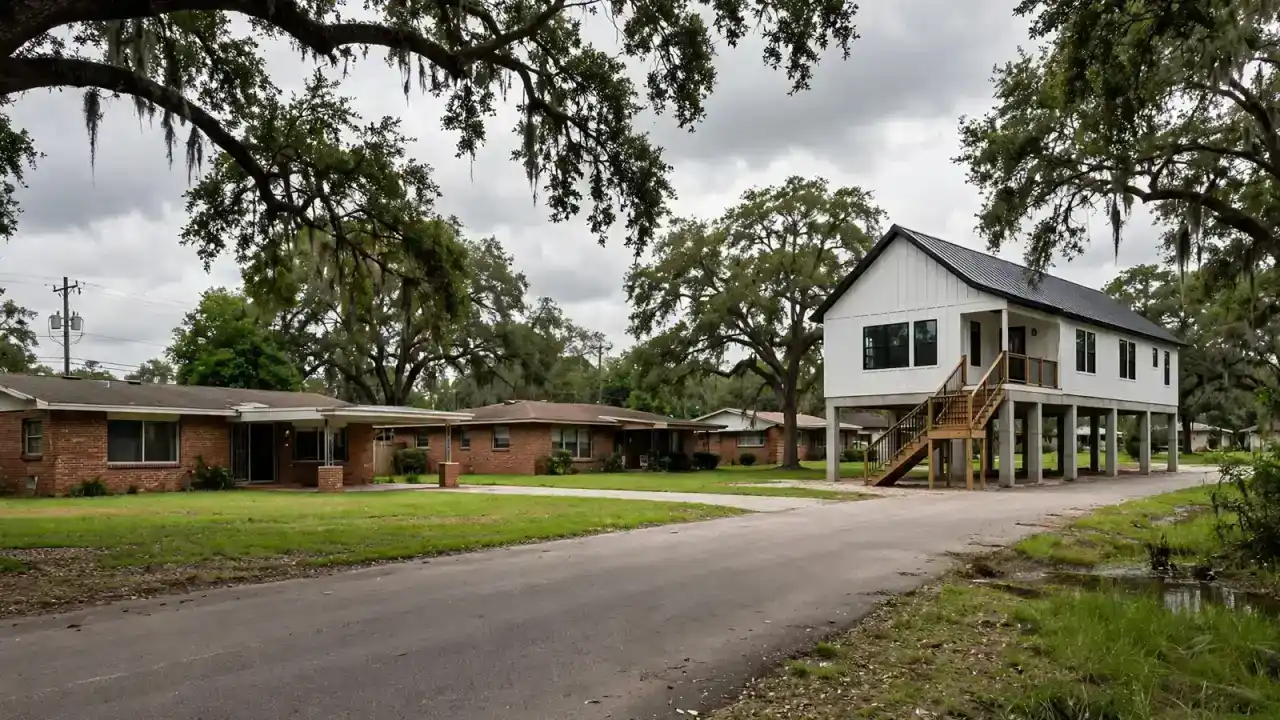
Key facts: Meyerland
- Meyerland was developed from 1955 as a planned community in southwest Houston [1].
- Brays Bayou runs through the neighborhood, and many homes flooded in 2015, 2016 and during Hurricane Harvey in 2017 [2].
- Many homes have since been elevated or rebuilt above flood levels.
- Mid-century homes may contain asbestos in some textures, tiles and insulation [3].
- The covered ZIP code for Meyerland on this site is 77096.
Coverage
Meyerland ZIP codes on this line
Calls from these Meyerland ZIP codes can reach an independent restoration contractor who works there.
- 77096Meyerland and nearby southwest Houston streets along Brays Bayou, including Meyerland Plaza.
About Meyerland
A mid-century neighborhood on the bayou
Meyerland was built from the mid-1950s on former rice farmland in southwest Houston, with curving streets of low brick and wood ranch homes, many in a mid-century modern style. It has long been the center of Houston's Jewish community, with synagogues, schools and a community center close by, and Meyerland Plaza as its shopping hub.
Brays Bayou runs through the neighborhood. In recent decades, severe floods hit Meyerland repeatedly, notably the Memorial Day flood of 2015, the Tax Day flood of 2016 and Hurricane Harvey in 2017. [5] Many owners elevated their homes several feet on new foundations, demolished and rebuilt above flood levels, or sold. The result is a patchwork of original ranches, raised houses and new two-story homes.
Housing
Housing types in Meyerland today
Original slab ranches
1950s and 1960s brick or wood homes on concrete slabs, often renovated after flooding.
Elevated homes
Original houses lifted onto new piers or raised foundations several feet above grade.
Rebuilt homes
New two-story houses built above flood level.
Mid-century moderns
Flat or low-slope roofs, large windows and open plans.
Townhomes and apartments
Along the edges of the neighborhood.
Homes with flood repairs
Walls, floors and insulation replaced in past years.
Flood history
Why flood history matters after a fire
Many Meyerland homes have been partly rebuilt after floods: lower drywall, insulation, flooring, cabinets and sometimes wiring replaced. That means a single wall may have old upper drywall and newer lower drywall, different insulation types and a mix of finishes. After a fire, knowing what was replaced and when helps restorers understand how materials will behave, where moisture may hide and what might contain older hazardous materials.
Tell your contractor and insurer about past floods and repairs. If you have records, photos or invoices from earlier work, keep them handy.
Home types
Restoration by home type
| Home type | Key restoration issues |
|---|---|
| Original slab ranch | Water under flooring; attic smoke over every room |
| Elevated home | Space under the house, new stairs, utilities on stilts |
| Rebuilt two-story | Smoke up stairwells; multiple AC zones |
| Mid-century modern | Low-slope roofs, large glass, exposed beams |
| Previously flooded home | Mixed materials; hidden moisture |
Elevated homes
Raised homes and the space beneath
When a house is lifted, its floor framing sits well above the ground, sometimes high enough to walk under. Utilities such as ductwork, plumbing and electrical lines may run beneath, often in insulated or enclosed chases. During a fire, smoke and firefighting water can reach this space. Drying and cleaning include the underside of the house, ducts and any insulation, and checks on the new stairs and decks that lead to the raised front door.
Firefighters may also have to work from ladders more often on a raised house, and access for restoration crews and equipment needs planning.
Mid-century modern
Mid-century modern homes
Meyerland has many mid-century modern houses with low-slope or flat roofs, exposed beams, clerestory windows and walls of glass. Fires in these homes can spread through open plans quickly, and smoke stains wood ceilings and beams that owners often value. Low-slope roofs need careful tarping so water drains rather than pools. Exposed beams are cleaned and sealed rather than replaced where possible, and large glass panels are cleaned or replaced to match.
Checklist
First steps after a Meyerland house fire
- 1
Wait for the fire department to clear the home
Stay out until officials say it is safe.
- 2
Report the loss to your insurer
Mention any previous flood claims.
- 3
Photograph every room and under the house
Include the raised foundation if there is one.
- 4
Close up the openings
Board windows and tarp the roof, especially low-slope roofs.
- 5
Start drying quickly
Houston humidity speeds mold on wet materials.
- 6
Gather past repair records
They help restorers plan.
Drying
Water from firefighting in a flood-scarred home
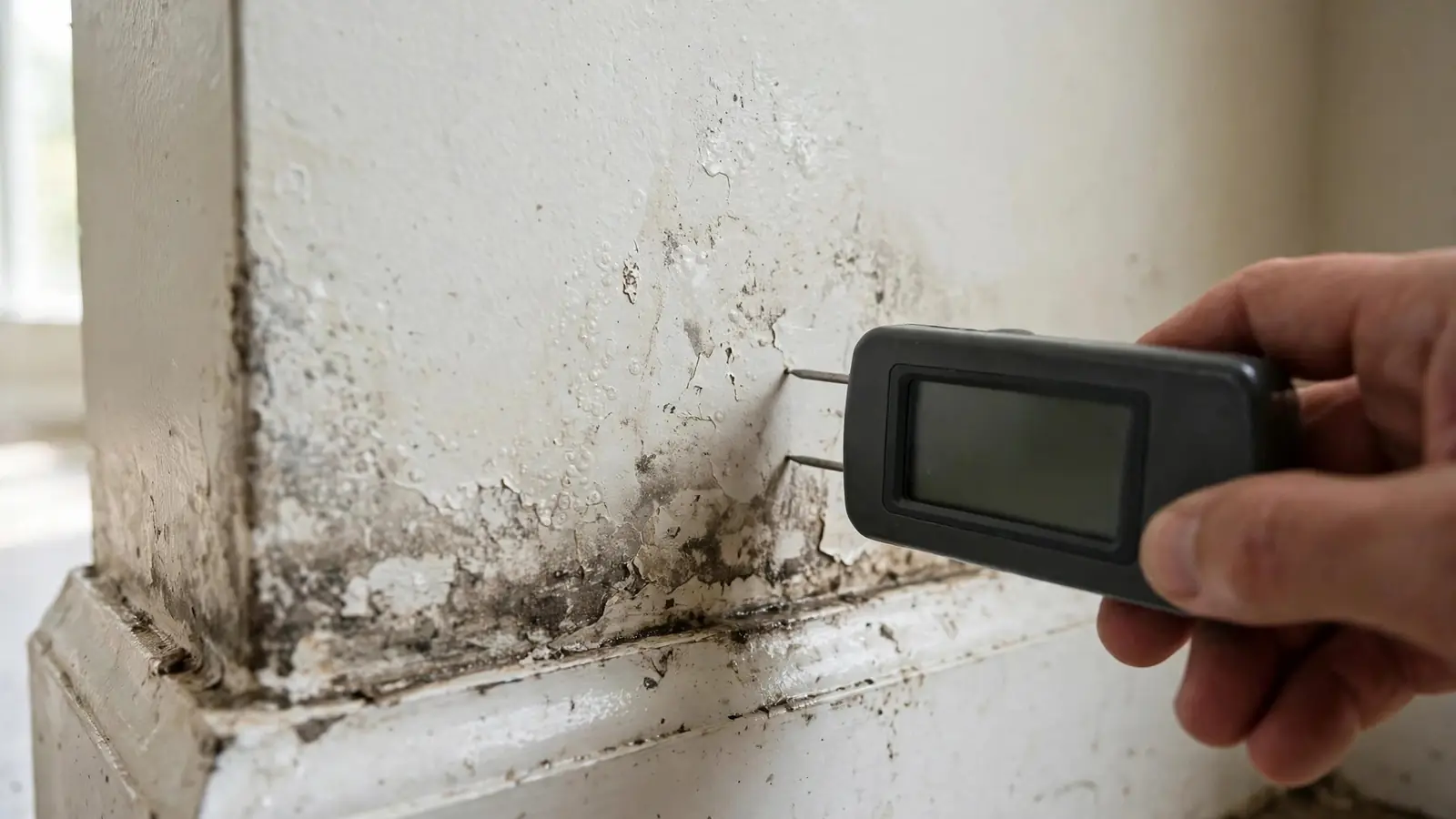
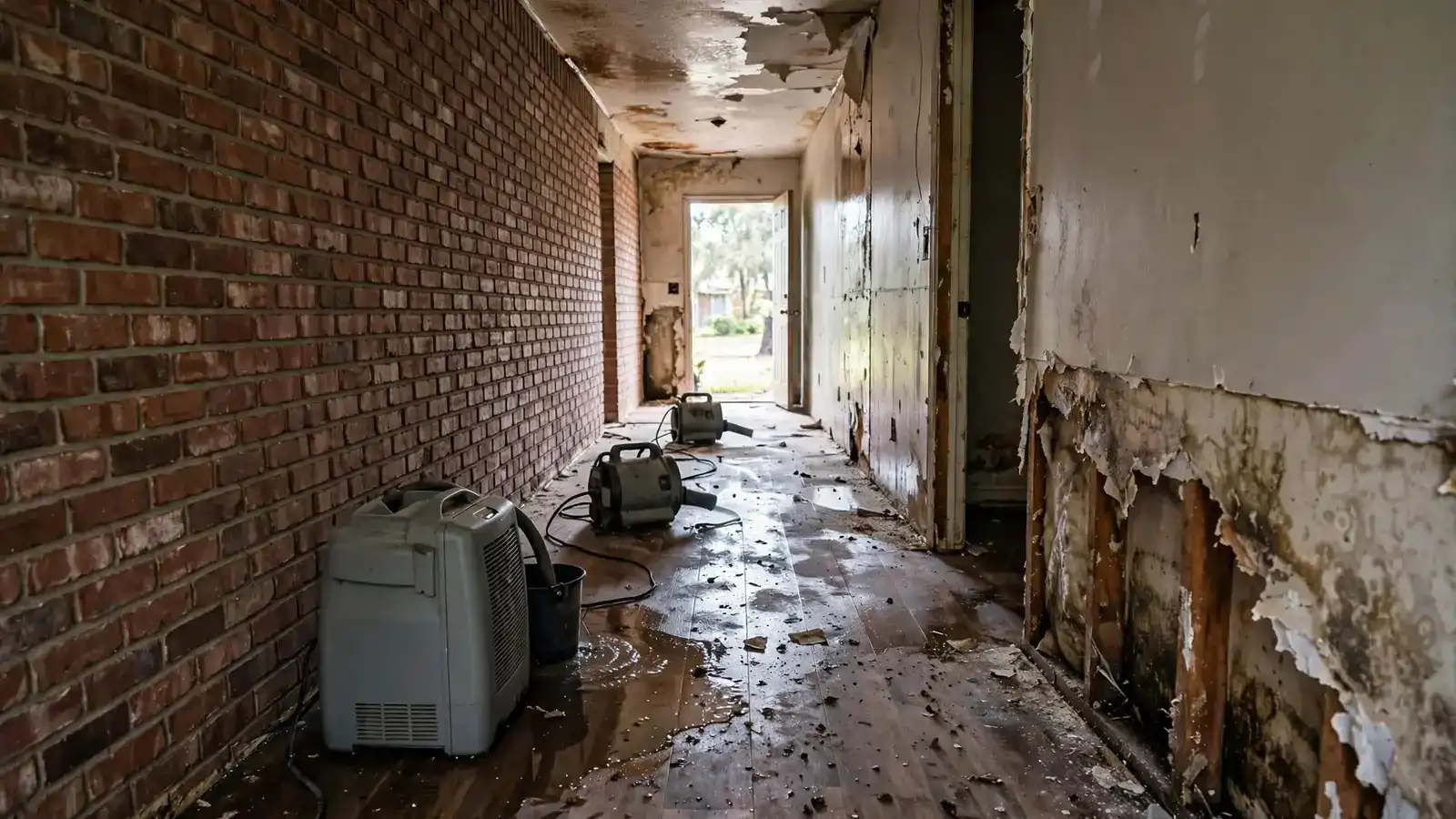
Homeowners who lived through floods know how quickly water damage turns into mold in Houston. Firefighting water is smaller in volume but dirtier, and it soaks the same places: lower walls, cabinets, flooring and insulation. Drying begins with extraction and moisture mapping, then dehumidifiers and air movers. In raised homes, the underside is dried too. Materials that cannot be dried, such as soaked pad and insulation, are removed.
Ask whether the contractor will provide moisture readings. If your home has flood vents or a raised foundation, make sure drying equipment and any temporary power are placed safely.
Community
The community around you
Meyerland's synagogues, schools and community organizations have long helped neighbors through floods, and they often help after fires too, with meals, temporary housing leads and practical support. If your family is displaced, it can help to tell your community leaders and your children's school.
Many families also have relatives nearby. Staying close to schools, work and places of worship makes a long restoration easier to manage.
- Tell your community
- Let schools know
- Stay close if possible
- Keep receipts for housing
- Ask about meals and support
Elevation
How Meyerland homes were raised
After the 2015 to 2017 floods, many Meyerland owners hired specialists to lift their houses. Crews cut the house free from its slab or piers, jacked it up several feet, built new foundation piers or walls beneath and set it down at the new height. Utilities were extended, new stairs or ramps added and the area beneath often left open, enclosed with lattice, or used for parking and storage.
From a fire restoration point of view, an elevated house is a hybrid: the rooms behave like a slab or raised house, depending on the original construction, while the space below adds a new area to inspect and dry. Ducts, plumbing and wiring under the house may be enclosed in insulated chases that absorb smoke and water.
New builds
Rebuilt two-story homes
New homes built on cleared lots since the floods are usually two stories, with living areas raised above flood level and sometimes a garage or storage at ground level. These homes have modern materials, open plans and often two AC systems. Smoke from a ground-level garage fire can rise into living areas above through stairs and shafts. Restoration follows the patterns of other modern Houston homes: start upstairs, clean stairwells and both AC systems, and dry any wet floors and ceilings.
Causes
Common fire starters in Meyerland homes
Kitchen fires
The leading cause of home fires nationally.
Holiday candles and menorahs
Open flames near curtains, paper and decorations.
Dryer vents
Long runs in renovated and raised homes.
Electrical work after floods
Rewired circuits should be checked after any fire.
Generators during outages
Placed too close to raised homes or garages.
Garage storage
Paints, fuels and batteries.
Candles
Candles and holiday safety
Candles are part of many celebrations in Meyerland, from Shabbat and Hanukkah to Christmas and Diwali. Keep candles and menorahs on stable, non-flammable surfaces, away from curtains, paper decorations and anything that can fall over, and never leave them burning in an empty room. Consider placing them in a window only if there is clearance from blinds and curtains. If a small candle fire happens, smoke can still spread through the house, and cleanup may be needed even when the visible damage is small.
Summary
Meyerland fire damage at a glance
| Topic | What to know |
|---|---|
| Housing | Original ranches, raised houses and rebuilt two-stories |
| Flood history | Many homes partly rebuilt; tell your contractor |
| Foundations | Slab, raised piers or new raised foundations |
| Older materials | Test before demolition in 1950s and 1960s homes |
| Drying | Fast and measured, including under raised homes |
| Community | Strong networks to lean on during recovery |
Commercial edges
Meyerland Plaza and commercial neighbors
Homes near Meyerland Plaza and along major roads such as Beechnut, South Post Oak and the 610 Loop sit close to shops, restaurants and apartments. A commercial fire can send smoke into nearby homes. Check filters, attics and vents after any nearby fire, and keep records if residue appears.
Choosing help
What to ask a contractor in Meyerland
- Have you worked on elevated homes?The space beneath needs inspection and drying.
- How will you handle mixed materials from flood repairs?Different drywall, insulation and floors respond differently.
- Do you test for asbestos and lead?Common in mid-century homes.
- How will you dry under the house?Equipment placement and safety matter.
- Can you protect exposed beams and mid-century features?Gentle cleaning preserves character.
Odor
Odor in homes that have flooded before
Owners who lived through floods know musty odor well. After a fire, smoke odor can mix with any lingering dampness in walls or under floors, making it harder to diagnose. Restorers separate the two: smoke odor is traced to residue in attics, ducts, closets and soft goods, while musty odor points to moisture and possible mold. Both are addressed at the source. Air fresheners and fogging alone rarely solve either.
Character
Restoring mid-century character
Many owners love the mid-century details of Meyerland homes: terrazzo or original tile floors, wood paneling, globe light fixtures, breeze blocks and built-in cabinetry. These can often be cleaned and kept after a fire. Terrazzo cleans well; wood paneling can be cleaned and resealed; original fixtures can be cleaned and rewired by an electrician. Ask your contractor to identify features worth keeping before demolition starts and to photograph them.
Under the house
Drying under a raised Meyerland home
The space beneath an elevated home needs the same care as the rooms above.
- 1
Check for standing water
Remove it with pumps or extractors.
- 2
Remove wet insulation
Under-floor insulation soaks up water and smoke.
- 3
Set equipment safely
Air movers and dehumidifiers away from utilities.
- 4
Measure joists and subfloor
Track readings daily.
- 5
Inspect ducts and plumbing
Check enclosed chases for water and smoke.
Family
Pets, children and older relatives
Meyerland has many multigenerational households. Older relatives and young children are more sensitive to smoke particles and mold. Arrange for them to stay elsewhere during heavy cleaning, odor treatment and demolition. Bring medications, mobility aids and comfort items when leaving. Pets should stay elsewhere too, and their bedding is usually replaced.
Rebuild or repair
Rebuilding decisions after a serious fire
When a fire seriously damages an older Meyerland ranch, owners sometimes consider whether to repair, elevate during repairs or rebuild. These decisions involve insurance, flood elevation rules, family needs and timelines. Restoration contractors can explain what can be repaired and what cannot. Building and floodplain rules come from the City of Houston. Take time to understand your options before demolition begins.
Outages
Outages, generators and raised homes
When storms knock out power in southwest Houston, many Meyerland households run portable or standby generators. Raised homes add a hazard: the open space beneath can tempt people to run a generator there, out of the rain. That space is not outdoors in a safe sense; exhaust can collect and rise into the house through floor openings. Keep generators in open air, well away from the house, and install carbon monoxide alarms on every level.
Insurance
What insurers usually ask after a Meyerland fire
Date and cause
The fire department report helps.
Photos and video
Of every room, under the house and outside.
Prior claims
Including flood claims on the property.
Repair history
Elevation, rebuilds and flood repairs.
Contents list
Items damaged, cleaned or discarded.
Receipts
Temporary housing and emergency purchases.
Original slabs
Slab ranches that were not raised
Not every Meyerland home was lifted. Many original slab ranches were repaired after the floods and remain at their original height, often with newer lower walls, flooring and cabinets. In these homes, firefighting water behaves as it does on any slab: it spreads under flooring, wicks up drywall and collects at the bottom of walls. Because these homes have been through flooding before, owners often recognize the signs of trapped moisture quickly. Drying uses extraction, moisture mapping and dehumidifiers, and lower drywall that soaked is often cut out again.
In short
Short summary for Meyerland owners
Tell the contractor and your insurer about your home's flood history. Dry fast, including any space beneath a raised house. Test older materials before demolition. Protect mid-century features worth keeping. Lean on your community for support, and plan where your family will stay while the work is done.
Bayou projects
Brays Bayou improvements and today's risk
Since the floods, Harris County and federal partners have carried out major work along Brays Bayou, widening the channel, replacing bridges and building detention basins to reduce flood risk. That work has changed the picture for many streets, but heavy rain can still overwhelm drainage. For a fire-damaged home, the practical point is simple: if repairs leave walls open or floors exposed during a rainy spell, keep an eye on drainage around the house and make sure temporary covers shed water away from openings.
Checks
Signs drying is incomplete in a Meyerland home
- Musty smell near lower wallsMoisture remains behind drywall.
- Cupping in wood or laminate floorsWater is still under the surface.
- Damp feel under a raised floorThe space beneath needs more drying.
- Peeling paint near baseboardsMoisture is rising from below.
Keepsakes
Contents and keepsakes after flood and fire
Families who lost belongings in floods often hold on tightly to what survived. After a fire, take care with photographs, documents, religious items and heirlooms. Do not wipe soot off photos or artwork. Wet papers and photos can be frozen in sealed bags until a specialist can dry them. Silver and brass can be cleaned before tarnish sets in. Make a list with photographs before anything leaves the house.
FAQ
Meyerland fire damage questions
Does my home's flood history affect fire restoration?
Yes. Earlier repairs change what is behind walls and under floors. Tell your contractor.
How is a raised house dried after a fire?
The rooms and the space beneath are both dried, including ducts and insulation under the house.
Can exposed wood beams be cleaned after smoke?
Often, with careful cleaning and sealing.
Do I need asbestos testing in a 1950s or 1960s home?
If work will disturb textures, tiles or insulation, testing is wise.
Will my previous flood claim affect my fire claim?
They are separate events, but tell your insurer about prior damage and repairs.
How do crews reach a raised front door?
With ladders, ramps or the existing stairs; access is planned before work.
Can a low-slope roof be tarped?
Yes, with care so water drains rather than pools.
Where can I stay during repairs?
Many policies cover additional living expenses. Ask your insurer.
Is the space under my raised house part of the restoration?
Yes, if smoke or water reached it. Ducts and insulation there may need cleaning or replacement.
Can a candle fire cause whole-house smoke damage?
Yes. Even small fires spread smoke through the home.
Can my terrazzo floors be saved after a fire?
Usually. Terrazzo cleans well after soot and water.
Should I raise my house while repairing fire damage?
It is a big decision involving insurance, city floodplain rules and your plans. Get advice before demolition starts.
Can I run a generator under my raised house?
No. Exhaust can collect and rise into the home. Keep it in open air, well away from the house.
Does a repaired slab ranch need different drying?
The approach is standard slab drying, but past repairs can mean mixed materials behind walls.
Who can help my family right after the fire?
The American Red Cross, your insurer, your community and your children's school.
Has the bayou work removed flood risk?
It has reduced risk for many streets, but heavy rain can still cause flooding. Keep repairs protected from water.
Can family photos be saved after smoke and water?
Often. Do not wipe them; freeze wet ones in sealed bags and ask a specialist.
How do I find out if my home was raised or rebuilt?
Check purchase records, permits and seller disclosures, or ask a previous owner.
Should I keep the fire department report?
Yes. Insurers often ask for the report number.
Can wood paneling be cleaned after smoke?
Often. It is cleaned gently and resealed if the finish was not damaged by heat.